In many organizations, project planning does not fail because of poor ideas or lack of expertise.
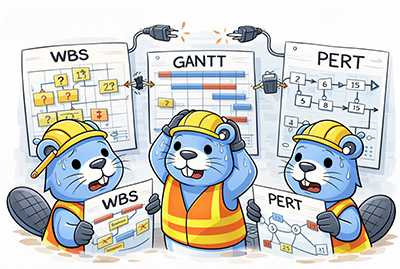
It fails quietly, every day, because information is scattered across too many tools.
Spreadsheets for schedules.
Slides for structures and explanations.
Diagrams drawn in separate applications.
Numbers copied, pasted, adjusted, and copied again.
What looks like flexibility on the surface often turns into hidden inefficiency, rising costs, and structural fragility.
The Hidden Cost of “Just One More Spreadsheet”
Excel and presentation tools are everywhere for a reason: they are familiar, powerful, and flexible.
But flexibility comes at a price when they are used as core project planning systems.
Every time information is duplicated across tools:
- Someone must manually keep it aligned
- Someone must verify which version is correct
- Someone must rework content after even small changes
This effort is rarely tracked as a cost, yet it consumes:
- Senior project management time
- PMO coordination effort
- Engineering and consulting hours
The project budget does not show it explicitly, but the organization pays for it anyway.
Fragmentation Creates Operational Risk, Not Just Inefficiency
The real problem is not only wasted time — it’s loss of reliability.
When project data lives in multiple disconnected artifacts:
- Assumptions diverge
- Dependencies are interpreted differently
- Updates are applied inconsistently
- Decisions are made on partial or outdated information
Over time, teams stop trusting the documentation and rely on informal explanations instead.
At that point, planning becomes fragile, and governance weakens.
Fragmentation is not neutral.
It actively increases project risk.
Coordination Becomes a Job of Its Own
In many projects, a significant portion of effort is spent not on planning or controlling the work, but on:
- Synchronizing schedules and diagrams
- Explaining differences between documents
- Preparing “alignment” meetings
- Fixing inconsistencies before reviews
This creates a paradox:
the more complex the project, the more time is spent managing documents instead of managing the project itself.
Coordination becomes an invisible role, absorbing value without producing it.
Why This Pattern Persists
Organizations keep using this approach because:
- Tools are already licensed
- Teams are familiar with them
- The inefficiency is distributed and hard to measure
- There is no immediate breaking point
But over the lifecycle of a project — or across a portfolio — the accumulated cost becomes substantial.
What seems inexpensive at the tool level becomes expensive at the system level.
Planning Needs Integration, Not Assembly
Project planning is not a collection of independent artifacts.
It is a single logical model expressed through different views:
- Structure
- Sequence
- Responsibility
- Cost
- Time
When these views are built separately, coordination is required.
When they are built from the same underlying structure, coordination disappears.
The difference is not cosmetic — it is structural.
Reducing Waste Means Reducing Duplication
The most effective way to reduce waste in project planning is not to work faster, but to:
- Eliminate redundant data entry
- Reduce manual alignment
- Minimize tool switching
- Ensure consistency by design
This frees professionals to focus on:
- Evaluating options
- Managing risks
- Making informed decisions
Not on reconciling files.
A Shift Worth Making
Modern project environments demand:
- Fewer tools, not more
- Integrated information, not assembled documentation
- Planning systems that reflect real project logic
Reducing fragmentation is one of the most direct ways to improve efficiency, lower hidden costs, and increase confidence in project decisions.
When coordination overhead disappears, planning becomes a management activity again — not a formatting exercise.
That’s why we decided it was time for a change and started designing iziPM with all the relevant features a project manager needs.
Want to know more?
If your’re interested in what iziPM has to offer, check out the product page or read why we think it’s time for a true, fully integrated Project Management software.